
Question Description
I’m working on a writing discussion question and need an explanation and answer to help me learn.
Refer back to the Learning Activity titled Applications of Volume and Surface Area. Problem 2 introduces a company that is trying to decide whether to manufacture cube-shaped or sphere-shaped tree ornaments. In your own words, explain what calculations were made, and why, in solving this problem. Why would a company be doing those calculations in the first place? If possible, give an example of a similar situation within your common experience in which the type of packaging shape is a variable for company decision-making.
Applications of Volume and Surface Area
Problem 1
A gas station has two cylindrical containers for storing gasoline. One has a diameter of 10 inches and a height of 12 inches. The other has a diameter of 12 inches and a height of 10 inches. Which container should the station order in bulk, if both containers are priced the same?
Step 1. Sketch a diagram and label with the appropriate measurements. What are the relevant formulas we might use for this problem?
Explanation
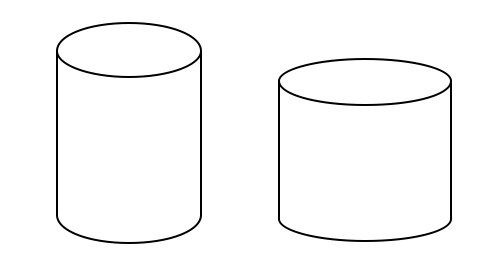
The relevant formulas for a cylinder are:
Because the cylinders are being used to store liquid, we are concerned with the volume.
Step 2. Identify all the known values you can substitute into the volume formula for each container.
Container 1: r = ______ h = ______
Container 2: r = ______ h = ______
Explanation:
Container 1: r = 5, h = 12
Container 2: r = 6, h = 10
Step 3. Substitute into the volume formula for both containers.
Container 1: ______
Container 2: ______
Explanation:
Container 1: V = ?(5)2(12) = 300?
Container 2: V = ?(6)2(10) = 360?
Step 4. Use your calculations to answer the original question. ______
Answer: The station should order the container with a diameter of 12 inches and height of 10 inches, because it will hold more gasoline per cylinder.
Problem 2
A company is trying to decide between a spherical- or cube-shaped tree ornament. Which ornament would require less paint?
- A spherical ornament with a diameter of 2.48 inches
- A cube-shaped ornament with a side length of 1.80 inches
Step 1. Sketch a diagram and label with the appropriate measurements. What are the relevant formulas we might use for this problem?
Explanation:
The relevant formulas for a sphere are:
SA = 4?r2
V = (4/3)?r3
The relevant formulas for a cube are:
SA = 6s2
V = s3
Because the ornaments are being painted, we are concerned with surface area for each.
Step 2. Identify all the known values you can substitute into the surface area formula.
Sphere ornament:
SA = ____________
r = ____________
Cube ornament:
SA = ____________
S = ____________
Explanation:
Sphere ornament:
SA = unknown
r = 1.24 inches
Cube ornament:
SA = unknown
S = 1.8 inches
Step 3. Substitute into the surface area formula for both spheres.
Sphere ornament: ________
Cube ornament: _________
Explanation:
Sphere ornament: SA = 4?(1.24)2 = 19 square inches
Cube ornament: SA = 6 (1.8)2 = 19 square inches
Step 4. Use your calculations to answer the original question.
Answer: The surface area is equivalent so the cost of paint for either will be the same. The company could go with either shape of ornament.
Try This!
If the diameter of the base measures 12 meters and its height measures 20 meters at the apex, approximate its volume.
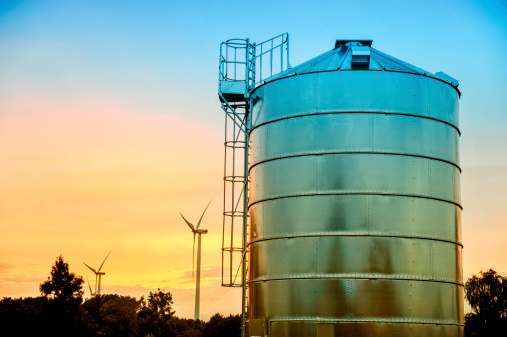 © Brejeq/iStock/Thinkstock
Solution: The silo is a compound figure consisting two parts, a cylindrical bottom and a conic top. The area of the base of both figures is the same, where the radius r = 6 meters, that is one-half of the given diameter. The height of the conic top is given to be one-quarter of the total height, that is
Therefore, we have the following cross-section
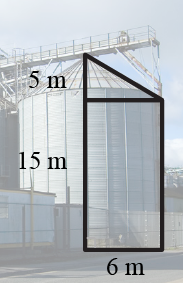
Next, use the formulas to find the volumes of each part of the silo. The total volume is the sum.
Answer: 1,884 cubic meters
Note. The material in this section was written by John Redden. Copyright 2014 Flat World Knowledge, Inc.
